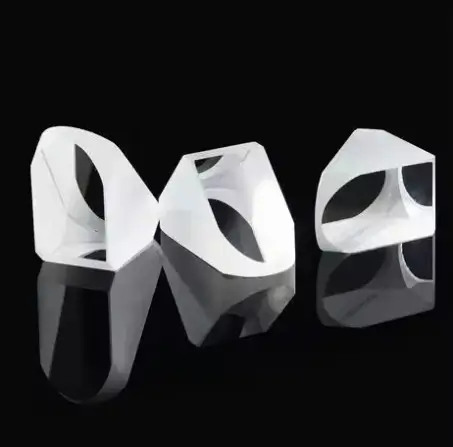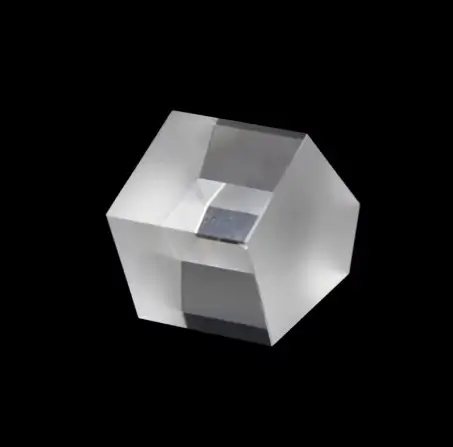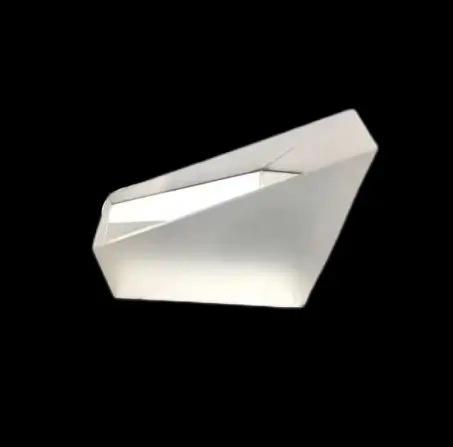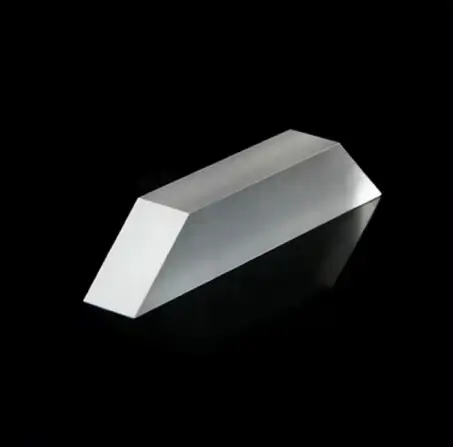


Depending on the rotation Angle of the prism and the incidence surface of the light, the image can be rotated, inverted or reflected backward. The bottom Angle of the Dove prism is 45°, which can be considered as the right Angle prism to remove the excess right Angle part, which reduces the weight of the prism and the internal reflection of stray light. When the Dove prism is used for image rotation or inversion, both the incident plane and the exit plane of the Dove prism are not perpendicular to the optical axis, but the direction of the outgoing light and the incident light is unchanged. At this time, due to the large incidence Angle, the beam will be fully reflected on the bottom surface of the prism, so the internal transmittance of the Dove prism is only limited by the absorption rate of the prism. When the Dove prism rotates θ Angle about the optical axis, the outgoing image rotates 2θ Angle in the same direction. If the incident light entering the Dove prism convergent beam, will introduce astigmatism, affect the image quality, so it is recommended to collimate beam incidence. In addition, due to the total reflection of the incident beam through the Dove prism, the phase difference between s wave and p wave will affect the polarization state of the transmitted beam.
| SPECIFICATION | |
| Material | BK7 grade A optical glass |
| Dimension Tolerance | +0.0/-0.2mm |
| Clear Aperture | >85% |
| Surface Quality | 60-40 scratch and dig |
| Angle Tolerance | < 3 arc minutes |
| Flatness | λ/2 @632.8 nm |
| Protective Bevel | 0.25 mm x 45° |

| Dove Prism | |||||
| Part No. | Material | Model | A (mm) | B(mm) | h (mm) |
| SDP101 | SF11 | 180° | 9.3 | 2.6 | 1.3 |
| SDP102 | SF11 | 180° | 14.0 | 5.0 | 2.6 |
| SDP103 | BF7 | Dove | 21.1 | 5.0 | 5.0 |
| SDP104 | BF7 | Dove | 42.3 | 10.0 | 10.0 |
| SDP105 | BF7 | Dove | 63.4 | 15.0 | 15.0 |
| SDP105 | BF7 | 180° | 80.0 | 20.0 | 20.0 |